We’re all going on a summer holiday – new Acas guidance for the vacation season

For all those HR stalwarts stuck in the office while their charges are off on holiday, here are some brief bits of news from Acas to help pass the time:

Acas’ Holiday Pay guidance has been updated, though not in any way which really helps employers still trying to work out what recent decisions mean for the detailed calculation. There are lots of references to overtime and commission being “included”, “considered” and “factored in” but no attempts to explain exactly how http://www.acas.org.uk/index.aspx?articleid=4109.

So far as non-guaranteed overtime is concerned (“we don’t have to offer it but you have to do it if we do”) a distinction is drawn between such overtime carried out on a “regular and consistent basis” (to be included within holiday pay, somehow) and that where overtime is “only used on genuine one-off occasions”), meaning what, exactly?  Just once?  In how long?  Can you even have more than one genuinely one-off occasion?  More importantly, what do you do about all the circumstances in the middle where overtime is more than a one-off but not regular or consistent enough to be described as, well, regular or consistent?

So at this stage, no change, no help and consequently no effective attack yet on the basic principle that if your employee cannot show that he has lost out on overtime or commission earnings through going on holiday, you should not have to pay him for them anyway.

No doubt written with Michael Gove uppermost in mind, a big hand please for the new Acas guidance on Career Breaks http://www.acas.org.uk/index.aspx?articleid=5754. This confirms the absence of any specific law on the point and the importance from the ER perspective of granting such breaks in a non-discriminatory manner, of being clear about rights to return and pay and statutory continuity, and in particular about writing down whatever is agreed in as much details as possible.

And last, as if keen to show that there is no niche in English employment practice too small for Acas assistance, a page (for it is only that) of new guidance on Working Temperatures http://www.acas.org.uk/index.aspx?articleid=5791.

This again confirms the absence of any specific law on the point – the temperature in the workplace must be that which a risk assessment indicates is “reasonable” in the circumstances. The Health & Safety Executive suggests a normal office minimum of 16oc, or 13oc where the work is mostly physical.  However, what is reasonable will be colder if you work with frozen food and warmer if you work in a bakery or iron foundry.  Alternatively, you may encounter either extreme without notice on any Thameslink commuter train.

Related to Working Temperatures is the little-aired issued of “thermal comfort”, not how warm or cold the office is but how warm or cold you feel.  This is actually a much better measure of compliance with the health and safety obligation to provide a reasonable physical working environment than air temperature alone, as comfort is also a function of humidity, air velocity, metabolic heat and clothing, whether personal or protective kit or uniforms provided by the employer.

According to Acas, thermal comfort is apparently the very embodiment of the saying that you cannot please all the people all the time. You will therefore have achieved the optimal level here when the number of your staff complaining about being too hot in any given workplace is more or less the same as those griping about being too cold.

Religious dress at work – where does the law now stand?

The vexed question of an employee’s right to manifest his religion in the workplace has twice raised its head in the EU courts in recent months. Employers seeking a definitive steer on the question should look away now.

Both cases deal with similar facts and contain exhaustive reviews of relevant considerations and authorities, and then appear to go in completely different directions. Though the cases in question are French and Belgian, the uncertainty they create as a result will affect English employers too, at least pending Brexit.  At this stage, these are merely non-binding Advocate General Opinions and the European Court of Justice itself is scheduled to say something definite on the point later in the year, but where do you stand in the meantime?

In Achbita –v– G4S, the ECJ has been asked to decide whether it is lawful in Belgium to prohibit a female Muslim employee from wearing a headscarf in circumstances where the employer also prohibits the wearing of any other outward signs of political, philosophical or religious belief at the workplace.  One Advocate General’s Opinion – yes.

By contrast, in the French case, Bougnaoui –v– Micropole SA, the question is whether the express wish of a customer not to have the employer’s services provided by an employee wearing an Islamic headscarf constitutes a genuine and determining occupational requirement such that the employer’s acting on that wish would not be unlawful discrimination.  A different AG’s answer – no.

So superficially we have a situation in which the employer can potentially impose blanket dress rules banning any form of religious manifestation, but cannot do so merely because it knows or believes that its customers want it. There are minor differences of law and fact between the two cases but at a practical level they are inescapably incompatible. So which is to be preferred (as a matter of law, rather than from a religious perspective)?

Both cases resolve around where you put the balance between the potentially conflicting rights of the business to run itself as it wishes and of the individual not to be discriminated against on the grounds of his faith. For this purpose the Bougnaoui Opinion makes it clear that discrimination on the grounds of manifestation of one’s belief is indistinguishable from discrimination on the grounds of the belief itself.  The Achbita Opinion said that so long as there was decent reason for the “no outward signs” dress code (here, the importance of overt neutrality in the employer’s staff), that balance lay on the side of the employer.  The AG in Bougnaoui thought otherwise and made a number of reasonably compelling suggestions for employers considering where that balance should lie.  In our view it is the Opinion more likely to be attractive to the ECJ.

Lessons for Employers:

  • The starting point for any analysis must be that an employee has in principle the right to wear religious apparel or a religious sign, but that the employer also has or may have the right to impose restrictions”.
  • When the employer concludes a contract of employment with an employee, he does not buy that person’s soul” [Editorial note – bit of a surprise for City law firms, that one]. “He does, however, buy his time”.  As a result, while the employer must balance rights to manifest with rights to run its business, it is not in any way obliged to tolerate proselytising, which has “simply no place in the work context”.
  • Given the employer’s legitimate interest in the consistent appearance of its staff, “where an undertaking has a policy requiring its employees to wear a uniform, it is not unreasonable to require that employees should do as much as possible to meet it” (for example, to require a particular colour or pattern for the headscarf).
  • What is proportionate [in determining where the balance lies] may vary depending on the size of the business…an employer in a large undertaking can be expected to take greater steps to make a reasonable accommodation with his workforce than an employer in a small or medium-sized one”.
  • The employer and employee will need to explore options together in order to arrive at a solution that accommodates both the employee’s right to manifest his religious belief and the employer’s right to conduct his business. While the employee does not…have an absolute right to insist that he be allowed to do a particular job within the organisation on his own terms, nor should he readily be told that he should look for alternative employment. A solution that lies somewhere between those two positions is likely to be proportionate”.
  • “Western society regards visual or eye contact as being of fundamental importance in any relationship involving face to face communication between representatives of a business and its customers. It follows…that a rule that imposed a prohibition on wearing religious apparel that covers the eyes and the face entirely whilst performing that involved such contact with customers would be proportionate. The balancing of interest would favour the employer”.  This sadly leaves unanswered the question of whether that visual or eye contact is also a necessary part of internal management and/or the maintenance of relations with one’s colleagues – we do not think that this should be about external contacts only.
  • In the last resort, the business interest in generating maximum profit should … give way to the right of the individual employee to manifest his religious convictions….Where the customer’s attitude may itself be indicative of prejudice…it seems…particularly dangerous to excuse the employer from compliance with an equal treatment requirement in order to pander to that prejudice.”

In summary, an employer will need very good reasons indeed before seeking to enforce any rule which bans the wearing of religious items or dress in the workplace. It seems clear that where this is for health and safety purposes, such a rule may be enforceable, but it is also clear that mere customer preference and protection of your bottom line will not be enough.

That is, with respect, easy for the AG to say. But where your business is heavily reliant on a particular customer there may be many more jobs dependant on that relationship than merely that of the religious adherent.  It is not hard to anticipate that after an appropriate crisis of conscience some employers might make a decision based precisely on protection of that bottom line, regardless of its other consequences.

Employees of one company can be whistleblowers at another – agency workers gain new protections

When it comes to explaining the importance of a new Employment Appeal Tribunal decision, there is nothing quite like a good story. However, the facts in McTigue -v- University Hospitals Bristol NHS Foundation Trust are rather dry and indeed nothing like a good story, so we shall settle instead for the (potentially really quite important) lessons to be taken from that case by employers.

In the broadest of terms, Ms McTigue was an employee of an employment agency which supplied her to UHB. She made a disclosure about malpractice to UHB, shortly following which it terminated her assignment.  She wished to argue that this was an unlawful detriment consequent upon her disclosure, but that required her to show that even though she was not employed by UHB and was employed by the agency, she nonetheless qualified as a whistle- blower to UHB.

The EAT concluded that she did, relying on sections 43K(1)(a) and (2)(a) Employment Rights Act 1996. Together these provisions mean that an agency worker who makes a disclosure to a hirer (i.e. the agency’s client) will, for all practical purposes, be a whistle-blower (provided still that the disclosure passes the other tests, i.e. that the maker reasonably believes it to relate to – usually – a breach of a legal obligation and that it is in the public interest that it be made).  That applies even if the worker is also a worker or employee of some other entity, such as the supplying agency, at the same time.

Lessons for users of agency staff

  • Treat disclosures by agency workers in the same way as you would those of your own staff. It may even make sense to draw the attention of new agency staff expressly to your whistle-blowing policy so that you have a modicum of control over the channel through which whistles may be blown.
  • Ideally this means being seen to treat disclosures reasonably seriously and not looking immediately for technical grounds on which they might be disqualified as protected. The longer and more obviously you spend time exploring reasons why the disclosure may not be protected, the greater will be the inference that you either have retaliated against the whistle-blower or intend to do so.
  • Depending on the nature of the disclosure, consider involving the employing agency if it is more about that company than it is about you.
  • Notify any of your own staff incriminated in that disclosure that you will not condone any impromptu retribution or retaliation on their part against the agency worker, any more than you would accept their doing so to one of your own employees. Ideally this should be in writing so that you can be seen to have taken reasonable steps to prevent that sort of response. Consider amending your policy to the same effect, and expressly to apply to agency workers.
  • Remember that the line between reacting adversely to the disclosure and reacting adversely to the manner in which it is made, while real in law, is very thin in practice. It is often the case that disclosures (or grievances including disclosures) may be advanced in terms which seem aggressive or confrontational. This may be a product of nothing more than nerves or anxiety or fear, but it can still lead the hirer to the understandable but technically entirely misguided conclusion that the worker would be happier somewhere else.  However, only if the manner of the disclosure is so poor as to be essentially serious misconduct in itself should any steps be taken by the hirer to, um, expedite the whistle-blower’s career options in this way.
  • Most obviously, because then it does not matter whether the agency employee is your worker or whether what he has said is technically protected, don’t retaliate. That does not mean at all that you cannot terminate the worker’s assignment or not sign his timesheets or decline to provide positive feedback, merely that you must be able to show some independent and unrelated basis for doing so.
  • Which means in practice that where you take steps to terminate an agency assignment or to have a particular individual taken off the job, etc., you need to retain a written record of why you chose to do so. This may very properly be skill-set, quality of work, attendance, timekeeping, end of project, run out of budget, etc. Unless supported by clear examples, however, try to avoid “loss of trust and confidence”, “attitude”, “poor relationships with colleagues”, etc., as all these could be seen as short-hand for the sort of mutual ill-will and resentment potentially caused by workplace disclosures.

Lesson for agencies supplying staff

  • Make sure that your contract with the hirer is clear that any liability arising from its unlawful retaliation against some disclosure made by the person you supply will remain firmly on the other side of the table and does not somehow become your problem.

Massachusetts Becomes First State to Ban Salary Histories in Applications

On July 23, 2016, the Massachusetts legislature unanimously passed a comprehensive pay equality bill aimed at eradicating gender-based pay discrimination. The governor of Massachusetts signed the bill on August 1, 2016, but the law will not go into effect until July 1, 2018.

The law requires that employers pay men and women equally when their work is “comparable,” i.e., when the work is “substantially similar” in skill, effort, responsibility, and working conditions. This is a broader standard than most states’ equal pay acts, which require proof of identical work for equal pay requirements to apply.  The law also bans salary secrecy, the practice of preventing employees from discussing their pay or benefits with one another.  The rationale is that greater openness among employees regarding their wages will help employees identify pay disparity along gender and other prohibited lines.

To encourage employers to voluntarily remedy past wage disparities, the law incorporates a three-year defense from liability for companies attempting to internally correct gender-based compensation disparities. During those three years, employers must complete a self-evaluation of their pay practices and demonstrate reasonable progress in eliminating pay disparities. If they do so, they are entitled to a rebuttable presumption that they have not engaged in gender discrimination.

One of the most unique features of the law is a first-in-the-nation law ban on employers’ soliciting candidates’ salary histories in the initial steps of the hiring process, a practice that critics claim can perpetuate discrimination against women.  The rationale is that women earn less on average than their male counterparts, and their depressed historical earnings can then factor into the wages offered to them by subsequent employers.  Postponing a discussion of salary history until after a conditional offer including wages has been extended reduces the risk that past discrimination will be perpetuated. Voluntary disclosure of wage history remains permissible.

Although Massachusetts employers have nearly two years to prepare for the law, they are advised to review their job applications now and prepare to amend them to eliminate mandatory wage history disclosures. Hiring managers should be trained not to solicit this information during the screening or interview process, while human resources professionals should review personnel documents to ensure that company policies do not prohibit employees from discussing their wages and benefits. Finally, Massachusetts employers should take the opportunity to review and remedy pay discrimination during the “rebuttable presumption” window, and ensure that required notices are posted regarding employees’ rights under the new law.

Civil Penalties Nearly Double for Form I-9 Violations and Significantly Increase for Other Immigration-Related Violations

Due to the implementation of the Federal Civil Penalties Inflation Adjustment Act Improvements Act of 2015 (Sec. 701 of Public Law 114-74) (“Inflation Adjustment Act”), higher fines and civil penalties have now gone into effect for assessments that occur on or after August 1, 2016. These higher penalties can be applied to violations that occurred after November 2, 2015, the day the President signed the Act into law.

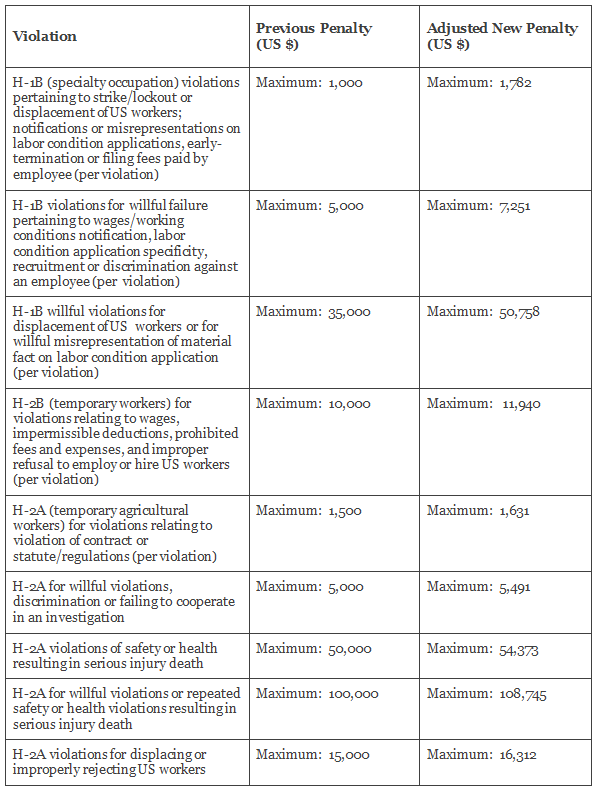
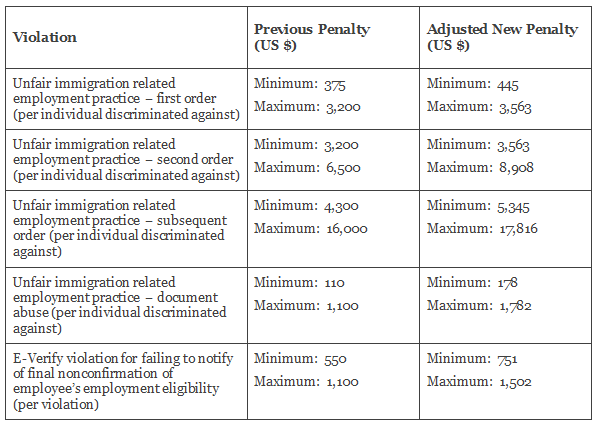
The Inflation Adjustment Act will be implemented by multiple federal agencies that have authority to assess civil penalties. The following is a summary, by federal agency, of the penalties covering violations for the unlawful employment of immigrant workers; violations related to Forms I-9; immigration-related discriminatory employment practices; and violations of the H-1B, H-2A and H-2B temporary visa for foreign worker programs. The increases in many categories are substantial. The penalties for Form I-9 paperwork violations are increased by an eye-catching 96 percent.

Department of Homeland Security fines:

Department of Homeland Security Fines

Department of Justice fines:

Department of Justice Fines

Department of Labor fines:

Department of Labor Fines

The consequence of the above is that employers should continue to aggressively monitor their immigration programs for compliance or suffer the harsher sting of these increased fines. Given that the penalties for I-9 errors are practically doubled, it is more important than ever to ensure I-9s are completed timely, correctly and are periodically audited. Moreover, most I-9 violations are considered continuing violations until they are corrected.

Pokémon Gone – when social media stops being a game

Do you know your Charmanders from your Bulbasaurs? Did you have a preferred method for catching Snorlax? Was your favourite move Hydro Pump?

If you have any idea what I am talking about, excellent. If not, please be assured that I am reminiscing about the nineties/noughties phenomenon that was Pokémon and do not require the medical assistance that these questions might otherwise suggest.

I am reminiscing because, as you may have seen, they are back! To say that the new Pokémon game is huge would be a horrible understatement, with millions of people worldwide downloading and playing the game.

However, some unlucky souls have not been able to get access. For example, at the time of writing, the game is not available in Singapore.  Sonny Truyen, an Australian working there as an expat was rather miffed by this and took to Facebook to express his views.  He decided the country as a whole was at fault and so criticised Singapore itself, with an eloquent dash of social media profanity, then accused its people of being stupid and claimed that the average IQ would fall if he left the country.  After some understandably peeved nationals became involved, this outburst wound its way back to his Singapore employer, which promptly sacked him.

Mr Truyen is unsurprisingly reported as accepting afterwards that “it was a very big error in judgment to negatively label an entire country over Pokémon”, (what, really?) though this may be little reassurance for any prospective employer, bearing in mind his role as SEO specialist.

Some employers and some countries are more willing than others to let this sort of thing go. Some might just have taken the view that “negatively labelling an entire country over Pokémon” said far more about Mr Truyen than it did about Singapore.  But what if he had been your employee sounding off about all or some part of your local community?

There are a whole range of inflammatory topics that can be plastered all over TwitFaceSnapInstaTube (not a new app, just a space-saving measure). The UK is currently coming to terms with the recent Brexit vote and associated political musical chairs, along with all of the social and racial tensions that have arisen as a side-dish.  People clearly have very strong views, which may well lead to heated debate on social media. Given this context, what if you receive complaints that one of your employees has been ranting on social media?  What if he has insulted or upset people with racist comments or “ordinary” abusive language?  Can you follow the approach of the Singaporean company and simply sack him?

Only actions serious enough to constitute gross misconduct are likely to justify summary dismissal (unless there are previous warnings still active). Clearly, if the rant takes place in a professional context, there are likely to be good grounds for gross misconduct.  For example, using a LinkedIn or Twitter profile which is clearly linked to the employer will come under employment auspices – actual or potential clients are likely to see the comments, may potentially be insulted and the employer’s reputation will likely be damaged as a result.

However, many social networks are totally personal in nature. You may have a Facebook or Twitter account which contains no reference whatsoever to your employer or your job.  If such comments are made on this type of platform, but you as employer become aware of them anyway – whether through a tip off from a Facebook friend of the accused who is also your employee (a frequent occurrence), or a particularly enraged reader who has stalked your ranting employee to find out his workplace– what can you do?

This may well depend on the seriousness and context of what was actually said. A heated debate regarding the rights or wrongs of Brexit, potential leaders of the Labour Party or a nuclear deterrent is rather different from a racist attack on an individual or a group.  The latter is clearly serious enough that it traverses the line between personal and professional and between lawful and unlawful.  But even if the words used were strictly lawful, you can legitimately consider how far, when work colleagues become aware of such an incident, they can reasonably be expected to continue working with that individual.  This could be highly damaging to the working environment and could very well be the basis of a fair dismissal.

This is in addition to the usual considerations of whether your company’s external reputation is damaged, where the incident and employer identity becomes public knowledge or goes ‘viral’, such as our Pokémon friend, and whether the conduct, even if not unlawful, nonetheless says something so damaging to the individual’s own professional credibility or judgment that he could no longer be seen as a safe pair of hands. All an issue of context, of course, but if you sell the judgment and discretion of your staff to your clients, it would not be hard for an employee to make himself irretrievably damaged goods in this way:

https://www.employmentlawworldview.com/broker-told-to-get-on-his-bike-after-twitter-joke-falls-flat/.

However, always be sure that you have investigated fully and followed reasonable disciplinary/dismissal process. Context will always be important and there may be factors relating to the accused that you cannot ignore, such as provocation or illegitimate access to his social media accounts.

Do me a favour – internships and the Bribery Act

Take a business, X Limited. It offers a range of “work experiences” from formal assessed fortnights for likely future employment candidates to a casual few days for the offspring of “friends and family”.  A good showing in the second category can get an interested individual into the first, so those slots are reasonably sought after.

One of the last intake to the second category performed miserably. X Limited would normally have let the placement run its course, offered some gently constructive feedback at its end (“Please don’t ever come back”) and thought no more about it.  The complicating factor is that the individual in question is the child of someone senior at one of X Limited’s bigger customers.

Cue crisis of conscience – does it now do the Right Thing, reject the individual for any chance of future employment and front it out with the parent at obvious possible risk to the business relationship or does it advance the candidate beyond the point which its capabilities would normally have dictated just to keep the parent sweet and hence (hopefully) retain or expand the business? [We are presuming here that it has already discarded the possibility of selling its rejection of the child as a positive virtue – if we regarded your offspring as bright enough to work here notwithstanding very considerable evidence to the contrary, you wouldn’t want to use us – admirable in its sheer cojones, maybe, but unlikely to appeal to any parent with the slightest pride in its progeny].  Specifically, would offering that individual a prospect of further progression towards a permanent job potentially constitute a breach of the Bribery Act 2010?

Section 1 of the Act makes it an offence for a person to give a financial or “other advantage” to another person, intending to induce that other person to perform “improperly” an activity carried out in the course of their employment.  Under Section 2, the person who requests or accepts such an advantage may also commit an offence.  There is no express reference to this situation in the statute, any decided case authority or the Ministry of Justice’s 2011 Guidance to the Act, but superficially this would seem a clear example of the sort of reciprocal back-scratching which the Act was partly enacted to prevent.

Lessons for employers

The closest the Guidance gets is probably in relation to corporate hospitality. It is accepted that the entertainment of clients or targets by a business will generally be legitimate if it does no more than “reflect a desire to cement good relations and show appreciation … [and/or] to improve the image of [the business] as a commercial organisation, to better present its products or services or to establish cordial relations”, all perfectly sensible steps to procuring favourable consideration of the business by that client or target.  However, in the very next paragraph in the Guidance we find this: “The recipient should not be given the impression that [it is] under an obligation to confer any business advantage or that the recipient’s independence will be affected”.  Therefore seeking a business advantage is fine, but expecting it is not.  Generating evidence of any express link between progressing the undeserving intern and receipt of more or any work from the client would therefore be most unwise.

There is the additional hurdle to liability under the Bribery Act that the “other advantage” (i.e. not excluding the intern from further consideration) must be intended to induce the client to act “improperly” – this would be very hard to prove beyond reasonable doubt in any circumstances where X Limited’s pure business proposition to its client is objectively little different from any of its competitors, such that there were equally valid (though perhaps differing) reasons for picking any of them.

So the Bribery Act does not put an end to the “grace and favour” intern, nor to helping a client’s sullen and unwilling offspring add a line or two to an otherwise barren CV. Just be careful that no one makes any express or implied suggestion to the client that you expect your concession to be reflected in work coming the other way.

While you can try to impose an internship policy governing who gets in and the admin around them, be awake to the likelihood that some of your client-facing employees may regard themselves as above such things and may make promises to clients regardless. A periodic written reminder from the top of the business will go a long way to allowing your company to show that it has taken reasonable precautions to prevent this and so escape the risk of a Bribery Act allegation.

Directors Beware – Australian Fair Work Ombudsman unafraid to pierce the corporate veil

Ignorance may not be bliss for company directors who seek to hide behind the corporate veil. A recent decision in the Federal Circuit Court has notably held that a company director can be found personally liable for breaches committed by a company by virtue of section 550 of the Fair Work Act 2009 (Cth) (FWA).

In Fair Work Ombudsman v Step Ahead Security Services Pty Ltd & Anor [2016] FCCA 1482, Step Ahead was held to have underpaid eight causal employees almost $23,000 by paying flat hourly rates and disregarding nine provisions of the Security Services Industry Award 2010 (Award). The breaches included a failure to pay the minimum rate of pay, casual loading, penalty rates, over time and shift allowances.

Notably, the court applied section 550 of the FWA to hold that the company’s director was also personally liable through his involvement in the company’s contraventions. Section 550 provides that a person involved in the contravention of a provision in a modern award will be taken to have contravened the provision in a personal capacity.

In one of the few cases to consider this section, the court found:

  • the director was the “controlling mind” of the company and aware of the Award requirements;
  • the contravention was deliberate and involved disregard for minimum standards in the payment of wages and entitlements;
  • neither the director nor Step Ahead had taken any steps to repay the underpayments to the employees, or showed any contrition; and
  • there had been a financial impact on the affected employees.

Taking these factors into account, and considering the need for general deterrence, the court imposed record penalties on Step Ahead and its director totalling over $308,000.  Step Ahead was ordered to pay just over $257,000 in penalties for its contraventions of the Award and the FWA and the director personally paid $51,408 in penalties for his involvement. These penalties were inclusive of a 20% reduction for the admission of breaches by both Step Ahead and the director.

In addition, Step Ahead and the director were jointly and severally liable to pay the underpayment amount of $22,779.72. To put it in perspective, the company’s failure to pay a mere $201.88 of overtime work attracted a hefty fine of $34,272.

The court also imposed an injunction restraining the director from underpaying security industry workers in the future. It will be interesting to see if he behaves himself considering his history with the Fair Work Ombudsman. The director had previously been the sole director of two security companies placed into liquidation, one of which had outstanding remuneration complaints.

Lesson for employers

  • The court also imposed an injunction restraining the director from underpaying security industry workers in the future. It will be interesting to see if he behaves himself considering his history with the Fair Work Ombudsman. The director had previously been the sole director of two security companies placed into liquidation, one of which had outstanding remuneration complaints.
  • Taking these factors into account, and considering the need for general deterrence, the court imposed record penalties on Step Ahead and its director totalling over $308,000. Step Ahead was ordered to pay just over $257,000 in penalties for its contraventions of the Award and the FWA and the director personally paid $51,408 in penalties for his involvement. These penalties were inclusive of a 20% reduction for the admission of breaches by both Step Ahead and the director.
  • Company directors and executives should be aware that they can be found personally liable for breaches of a company by virtue of section 550 of the FWA. Sole directors are at particular risk of exposure as it would be hard to argue they were not involved in the company’s contravention.

Response to BIS Call for Evidence on Restrictive Covenants

The deadline for responses to the BIS call for evidence in relation to the use of restrictive covenants expires on 19 July.

The Call contains no hard evidence at all to support any suggestion that covenants stifle start-ups. It admits that this is only an assumption, though even those are normally based on something.  It also pays no obvious heed to logical inevitability that if one business benefits from limitations on the use of restrictive covenants, another must suffer, itself potentially a start-up knocked sideways by the departure of a key employee to the competition.

Spoiler alert – neither we nor our survey respondents could come up with any convincing reason to change the law relating to covenants, let alone any actual practical means of doing so, without creating colossal peripheral damage to industry and enough satellite litigation to fill the Courts for years.

There might possibly be a case for some ACAS code-like guidance on the use of covenants. This could be some principle-based pointers which could focus employers’ minds on what they needed and where non-compliance would not necessarily be fatal to enforceability but would at least require a good explanation.

Instead or in addition, BIS’ repeated references to a lack of transparency in covenants (again sadly unburdened by any actual, y’know, evidence) might also suggest a push to require contracts containing restrictive covenants to be formally – perhaps independently – explained to the employee pre-signing. Is it just me, or would you expect the sort of employee likely to generate protectable interests for covenant purposes not to read their contract first or, having read it and miserably failed to understand it, to sign up anyway?

We shall see what comes of it all, if anything. In the meantime, here is our Response containing some fuller commentary on the questions in the Call.

http://media.squirepattonboggs.com/pdf/Employment/Call-for-Evidence.pdf

EEOC Gives Employers Extra Time to File EEO-1 Pay Data Reports

The Obama Administration, together with the Equal Employment Opportunity Commission (EEOC) kicked the year off with a bang on the equal pay frontier, announcing a proposed rule that will revise the EEOC’s longstanding Form EEO-1.  The proposed rule was published on the Federal Register website on February 1, 2016 and a public comment period was opened until April 1, 2016.  The public spoke and the EEOC listened.

Data currently collected from EEO-1 reports provides the federal government with workforce profiles that are sorted by race, ethnicity and gender. The original proposal, announced on January 29, 2016, would have required federal contractors and employers with 100 or more employees to provide pay data to be included in EEO-1s beginning with the September 2017 report. According to EEOC Chair Jenny R. Yang, the additional data collected would be a “significant step forward in addressing discriminatory pay practices. The proposed rule sought to employ an updated and improved online data collection mechanism to ease the compliance burden on employers.

The revisions announced on 13 July 2016, appear to be a direct response to commentary by employers about the burdens imposed by the EEOC’s initial proposals. It gives employers additional time to prepare for the additional EEO-1 reporting requirements and also move the EEO-1 filing deadline to align with W-2 reporting. Under the revised proposal, for the upcoming 2016 EEO-1 report, the filing deadline will remain September 30, 2016. However, beginning with the 2017 report, the reporting deadline for all EEO-1 filers will be March 31st of the year following the EEO-1 report year. Thus, the 2017 EEO-1 report will be due on March 31, 2018. Changing the filing deadline will give employers six more months to prepare their recordkeeping systems for the 2017 report, and it will give them 1.5 years without filing an EEO-1 report (September 30, 2016 to March 31, 2018). At the same time, this change will align the EEO-1 with federal obligations to calculate and report W-2 earnings as of December 31st; the EEOC will not require a special W-2 calculation for the EEO-1.

The Notice was published in the Federal Register on July 14.  There is a 30-day public comment period on the revised proposal until August 15, 2016.

For the moment, the bigger story is not the rule change itself, but the ability of the public sector and private sector to work together to make a meaningful push to address the gender pay gap in an efficient way.  According to Ms. Yang, the revisions to the proposed rule came about as part of the EEOC’s effort to “think about how [it] minimize[s] the burden on employers.”  Addressing the gender pay gap remains an important item for the EEOC.

LexBlog