
Paddington Bear, the UK’s most loveable immigrant: once welcomed, now ostracised? And at what cost to us all?

As Paddington Bear prepares to make his Hollywood feature-film debut this December, the Employment Law Worldview Blog takes a ‘paws’ to ponder on the polite, accident-prone bear from Peru, dubbed “the UK’s most lovable immigrant”. Had Paddington Bear arrived at our shores today, would he still be taken in and welcomed as warmly as he once was? Perhaps Henry and Mary Brown and the twins might have read a few of our more populist newspaper headlines online and resolutely decided to send our much loved bear elsewhere?

Firstly, let’s pretend, for the sake of argument, that Paddington wasn’t in fact (ahem) an illegal immigrant to the UK.  Let’s say that this time he wants to do it properly: i.e. with a valid visa.  Let’s also assume that Paddington is still starting out in life so a) he doesn’t have £1 million to invest in the UK to be eligible for a Tier 1 Investor visa; and b) with ‘Brand Paddington’ still just a glimmer in his brown eyes at this stage, he is not interested in applying for a Tier 1 Entrepreneur visa, plus he doesn’t have the required £200k in funds  to invest in his own, or another’s business in the UK, having, say, spent the lot in a frenzied marmalade binge back in Peru.

Let’s also say, for the sake of argument, that Paddington has his beady eye on taking a degree level qualification in the UK and then seeking to build his future career here. In the past he could have relied upon the Tier 1 Post Study Work (PSW) route, which provided non-EEA graduates from UK universities with two year visas enabling them to take up employment in the UK and gain valuable work experience here.  However, in a measure by the Government designed to curb net migration, this closed to new applicants in April 2012. The result? – university applications from essential wealth-bringing international students are in decline and our universities are suffering. In the meantime, the international ‘brightest and best’ that the Government insists the UK is still attracting are in fact applying to study  in countries such as the USA, Canada and Australia (countries which still maintain post study work visa options, not coincidently).  Does this mean that Paddington Bear is stuffed?

Other measures designed to cut net migration include the closure of the Tier 1 (General) category in April 2011. Had Paddington got his degree elsewhere, for example, and worked a bit before deciding to come to the UK, this category could have afforded him the ability to work in the UK in any capacity, even setting up his own business, before being eligible for permanent residency at the end of the 5-year period (provided he had earned a sufficient income here and basically made a success of things). Not any more, also closed.  The only option for employment in the UK for non-EEA nationals is currently through sponsorship under Tier 2.

It is well-known that the Government will fail to to achieve its target of reducing net migration to ‘tens of thousands’. Conversely, so serious (according to some) have been the negative effects of the closure of the PSW category on the UK that the All-Party Parliamentary Group on Migration (APPG) is currently conducting a public call for evidence into the closure of this category and the impact UK universities, businesses and the economy.

We been active in our commentary on this area the past – see previous  posts on our Employment Law World View blog on 3 February  (https://www.employmentlawworldview.com/is-britain-kicking-out-bright-foreigners/) and 16 May 2014 (https://www.employmentlawworldview.com/dyson-exposes-vacuum-in-home-offices-position-on-visas-for-non-eu-graduates/). Current Government policy on curbing immigration and the effect on UK plc has been the subject of consistent media attention, most recently in a serious of articles in the Financial Times based on a report undertaken for it by the Migration Observatory at the University of Oxford.   This focused on the effects of policy changes and the economy on highly skilled migration to the UK from 2007-2013. (http://www.migrationobservatory.ox.ac.uk/reports/highly-skilled-migration-uk-2007-2013).

According to the report Government curbs on highly skilled migrants have “shrunk the pool of international talent available to business” and employers are now having to look elsewhere from within the EU to fill skilled jobs that they are unable to fill from within the UK.  All we have domestically is Winnie the Pooh, by his own admission a bear of Very Little Brain.

Sponsorship of non-EEA nationals under Tier 2 remains an option, but so complicated and onerous are the compliance duties forced onto Tier 2 sponsors that this is inhibiting their ability and desire to recruit from outside of the EU. A recent Evening Standard article quotes a leading recruitment consultancy firm as saying, “small businesses would rather leave a role vacant than get it wrong”.

Statistics remain persuasive that Government immigration policy, such as the closure of the PSW category has been and remains, detrimental to businesses and the UK economy. Whilst skills shortages remain from within the UK, curbs on migration will not help. Employers are forced to look elsewhere, and the only place left is from within other countries from within the EU and this is a smaller pool than the pool of international talent. As the Evening Standard article states, issues with UK education and the production of home-grown talent “will take generations to fix” and “pulling up the drawbridge until we do so will not help the British economy”. Suitably bright and qualified immigrants, such as those coming to the UK for higher level education, rather than  ‘steal’ jobs from UK residents will in fact generate wealth and create jobs if they are encouraged to remain in the UK after studying here.  A Paddington hard stare for the Government would seem quite in order.

So in light of the above, what if our dear Paddington started thinking twice about the UK now? What if Aunt Lucy foresaw a better future for him in the USA?  Instead of the marmalade-eating, wellington boot-clad, politest of bears we all know and love, Paddington could instead be sat comfortably on a small fortune in Silicon Valley,  30 million book sales under his duffle coat, missing only marmalade and Portobello Road market.

What a sad thought for us all here.  How less richer and deeper our cultural history, not to mention his contribution to the UK economy through book sales, tourism, stuffed toys and marmalade sales. Talent invariably goes on to equal success. Talent comes in all shapes and sizes, and some of the world’s most successful people – and brown bears – come from the most inauspicious of backgrounds.  We should remain firmly welcoming to the migrants of this world (not illegal, but who doesn’t love Paddington Bear?).

US Appeals Court Says Collective Action Waiver in Separation Agreement Unenforceable As Improper Limit on FLSA Rights

As we’ve reported here and here, recent decisions from the US Supreme Court, federal appellate courts, and more recently, even the California Supreme Court (see here) have clarified that class and collective action waivers in arbitration agreements, including those that waive employees’ right to bring a claim under the federal Fair Labor Standards Act (FLSA) on behalf of themselves and a group of similarly situated employees, are enforceable.  Employers favor arbitration agreements containing these waivers because they require an employee who, for example, believes that he or she has a claim for unpaid wages, to bring that claim only on an individual basis, and in arbitration, rather than in court and on behalf of not only the individual employee filing the lawsuit, but perhaps dozens, hundreds, or even thousands of employees.

In Killion v. KeHE Distributors, Inc. [pdf], the Sixth Circuit Court of Appeals addressed a related, but significantly different situation involving class and collective action waivers.  In that case, the employer terminated approximately 70 sales representatives as part of a restructuring.  It offered the employees severance pay as part of a separation package.  In return, the employer requested that the employees sign release agreements that, among other things, included a waiver of the right to bring collective action claims under the FLSA.  Not long after the ink was dry on these agreements, several employees sued the employer, asserting a collective action claim on behalf of themselves and the other terminated sales representatives for unpaid overtime compensation under the FLSA.

The employer argued that the collective action waiver in the separation agreements signed by the employees prohibited them from bringing the collective action FLSA lawsuit.  It pointed to the cases we’ve discussed in prior blog entries – American Express, D.R. Horton, Inc., and others – enforcing collective action waivers as part of agreements to arbitrate claims.  The court, however, disagreed.  It relied on the fact that the separation agreements here contained no agreement to arbitrate any claims, only a waiver of the right to bring a collective action claim.  It explained that in the absence of any agreement to arbitrate, the court’s prior decision in Boaz v. FedEx Customer Information Services, Inc. [pdf] applied.  In that case, the court held that restrictions on FLSA rights are unenforceable, and that an employee cannot waive their right to participate in a collective action.  Thus, the court in Killion reversed the lower court’s ruling that held that the collective action waivers in the separation agreements were enforceable and prevented the sales representatives from bringing a collective action claim under the FLSA.

This case is significant in that it demonstrates that the rationale that courts have relied upon to approve and enforce class and collective action waivers – the strong federal policy of enforcing agreements to arbitrate under the Federal Arbitration Act – is not present when there is no agreement to arbitrate.  Accordingly, it appears that, at least in the Sixth Circuit, an FLSA collective action waiver is only enforceable when it is part of an arbitration agreement, and is not enforceable as part of a separation or other release agreement when arbitration of claims is not agreed upon as an alternative dispute resolution procedure.

Employment Mediations – An Insider’s Guide, Part 4

This is the next in our re-run of a series of posts on employment mediations written for us by Caroline-Sheridan.

Sometimes the parties to a mediation are asked to provide the mediator in advance with a “position paper”.  This is a document of a few pages (as a rough rule of thumb, the equivalent of five minutes’ talking).  It sets out in broad terms how the parties have got to where they are, how they feel about that and where they want to get to.  Often the phrase used here is what they “want tomorrow to look like”.

A position paper is not generally a compulsory part of a mediation (it is very rarely requested in judicial employment mediations, for example) but it can be helpful to both the mediator and the parties themselves.   Sometimes they are for my eyes only and sometimes they are written expressly with a view to being exchanged between the parties.  It does not matter much which, as obviously there is never any exchange unless I have the agreement of all concerned.

From my perspective as mediator, a position paper can help me make prior sense of a dispute where either there is very little documentation (for example a falling-out between colleagues) or where the paperwork is voluminous or badly-organised.  It can certainly be helpful during my preparatory work to have my attention drawn to particular key documents.  After all, the less time needed to set out these basics at the mediation itself, the greater the time the parties can apply to the process.  A position paper can also help me assess in advance the intended approach of each party to the mediation.  While the tone and demeanour which each adopts is ultimately a matter entirely for them, ignorance or anxiety can sometimes lead position papers to come across as particularly unrealistic, insulting or uncompromising.   In those circumstances I would tend to have an “Are you sure?” conversation with the party, just on the basis that its continuing that approach in the mediation itself might increase the risk that the other would walk away.

The preparation of a position paper can also help the parties themselves.  The mere process of reducing their thoughts and aspirations to paper can help bring order and a strengthened degree of realism to their thinking.  In addition, when it comes to their opening statements, the position paper can often act as a script (or the basis of one) for what can be a daunting moment (see next post).

So the position paper is mostly good news.  But all that said, I would never insist on one if I thought that the mere process of writing it would be off-putting to a party.  They might have limited writing skills or fear (quite unjustifiably) that their paper will somehow be “trumped” in my eyes by a more polished product from a professional representative.  They may just feel happier to talking to me than writing, and that could make any requirement for such a paper an obstacle in their mind to the mediation itself.  Under those circumstances, while not preventing the other party doing such a paper for its own use, I would not ask either to produce one.

Next, there you are in the mediation room with the other side, the process just kicked off.  The mediator turns to you and asks you if you have anything to say.  What should be in your opening statement?

US Nonimmigrant Visa Applications Experiencing Worldwide Delays

This past week the US Department of State announced, through its Bureau of Consular Affairs, that Embassies and Consulates are experiencing technical problems with the passport and visa system. While the system is supposedly operational, the Bureau reports that posts are issuing documents at a reduced capacity. This issue is worldwide and is not specific to any particular country, citizenship document, or visa category.

Many visa applicants have been waiting several days to receive their passport and visa after notification that their visa application was approved. Despite the outage, consulates are still conducting visa appointments. Furthermore, the online systems for completing visa application forms and making interview appointments remain in operation.

For further updates regarding this situation please consult travel.state.gov and follow this blog. For assistance with urgent situations, please contact your principal Squire Patton Boggs professional.

The Social Action, Responsibility and Heroism Bill – a new low in UK Legislative proposals

Anything designed to reduce the burden of regulation on employers must be a good idea, right?  Well, not necessarily, no, and certainly not the proposed Social Action, Responsibility and Heroism Bill, a legislative proposal defective from conception to execution in almost every way it is possible to imagine.  

The Bill is designed, says proud sponsor Justice Secretary Chris Grayling, to “slay the health & safety culture” and that other pet hate of Daily Mail readers everywhere, ambulance-chasing lawyers advertising on daytime television.  It is Mr Grayling’s view, his advisers tell him, that fear of personal injury claims from employees is deterring would-be employers from hiring new staff.  

The Bill requires a Court considering whether an employer has been negligent or breached a statutory duty to have regard to whether it (i) was acting for the benefit of society; (ii) demonstrated a generally responsible approach towards protecting the safety of others; and (iii) was acting heroically by intervening in an emergency to assist an individual in danger.  

And that’s it, the work of scarcely a page.  The draft is unburdened by definitions, and so offers no clue as to what is meant by “for the benefit of society”, “heroically” or “generally responsible approach”.  As a means of generating further remunerative work for those same lawyers through endless satellite litigation on those points, this is a masterstroke.  The Courts themselves may justifiably wonder whether “have regard to” means that they can (or must?) find someone acting for the benefit of society not to have been negligent in circumstances where someone less public-spirited who did exactly the same thing would be.  Or is it a quantum issue only, i.e. that if you are injured by the negligence of a “generally responsible” employer, you should receive less compensation than for the same injury caused by the same negligence on the part of an employer with a generally more cavalier approach?  

Aside from the drafting, what about the objective of the Bill – to make people less likely to blame others for their own negligence or foolishness?  “I think perhaps [there is] too little inclination to say “it was me that messed that up”.  We are a bit of a society that is a bit too inclined to blame someone else”, Mr Grayling told The Telegraph in somewhat halting English.   He continued: “It is about trying to restore common sense to the kind of situations which happen all too often and very seldom get to Court – where somebody…does something dumb, hurts themselves and sues the employer anyway.  For responsible small businesses it is a real headache and most of the time they just pay up because it is less hassle to do so”.    

So the reality even in Mr Grayling’s own case is that employers pay out because health and safety proceedings are “hassle”, not because they fear losing.  Nothing in this Bill makes the remotest difference to that, since by definition it forces the employer all the way to Court before its provisions would apply anyway.  The provisions are too ill-drafted to offer any greater certainty of outcome even when you get there and the Courts already have a very wide discretion to find against unmeritorious claimants and those who brought their misfortune upon themselves in whole or part.  In particular, the Bill completely fails to consider the position of the injured person – if my health, career, life is destroyed because of someone else’s negligence, it will be no compensation to me that the person who did this to me has a generally (though not in my case) responsible approach to worker safety.   

Somewhat against the run of informed opinion, one commentator has described the Bill as “Chris Grayling’s finest hour” – it is only on closer reading that it becomes clear that his article is so laden with sarcasm that it can scarcely stand up.  It is impossible to disagree.  Employers and society generally deserve much better than this.

Employment Mediations – an Insider’s Guide, Part 3

This is the next in our re-run of a series of posts on employment mediations.

In Part 1 of this series I referred to some of the basic principles underlying a successful mediation. But why should the parties consider themselves bound by them? This is where the formal mediation agreement comes in.

CEDR mediators will tend to start with the CEDR model agreement. The parties have the right to vary that document but only by agreement, and in my experience alterations of substance are relatively rare.  So what can you expect to be asked to sign up to?

1.         First, a commitment that the mediation process represents a good faith attempt by each party to settle.  Though this is just words and in that sense no more legally enforceable than an oral statement to the same effect, it is a representation which the mediator can more easily refer a party back to by virtue of its being in writing.  It may also be of some reassurance to a party otherwise sceptical of the other’s intentions.  The model agreement refers to just three parties, usually employee and employer, plus the mediator.  In disputes with more moving parts, for example two employees at odds plus an employer which will need to be involved in the resolution between them, the cast list may grow.

2.         To avoid arguments at a late point, a promise that the attendees for each party have full authority to bind it by the terms of any settlement.

3.         An express reiteration of the confidential and without prejudice “bubble” around the process.  It requires the parties to agree that they will not call the mediator as a witness in any proceedings, nor make any application for disclosure of his/her notes.  The agreement also prohibits the mediator from giving evidence or producing case notes voluntarily.

4.         The CEDR model agreement provides that no settlement reached at the mediation will be legally binding until set out in writing and signed by the parties.  This is not always adhered to, especially where the mediation moves into facilitation territory and a mutual clarification or clearing of the air may make the necessary difference without anything more formal than a handshake. Pushing the parties to put something in writing in these cases can force them into defensive positions and so be counter-productive. However, if the mediation is to resolve a live dispute where the employee has brought proceedings or is still in time to do so, then a settlement in the form of a statutory settlement agreement is most usual.

5.         Last, the mediator’s fees.  The default position under the model agreement is that these are split equally between the parties.  Sometimes just to get the thing underway the employer will agree to pay the whole cost, but be aware that who pays the fee is a matter of no interest to the mediator and you get no “brownie points” as employer in such a case.

Next, if you are asked to provide a position paper in advance of the mediation, what should it say to be most helpful to the process?

No help from UK Courts for “absurd” non-competition covenant – over to you, employers

A strong message to employers from the Court of Appeal this week to check your restrictive covenants, but this time to do it properly.  None of that just casting an idle eye over the relevant page of your executive’s contracts – description of territory, tick; vague reference to competition, tick; not wholly fanciful restraint periods, tick, etc.  

In Prophet Plc –v- Huggett the Court of Appeal was determining the enforceability of a non-competition covenant in Mr Huggett’s contract with Prophet.  It engaged in a word-by-word analysis of what the covenant actually said and reached the conclusion that it prohibited Mr Huggett from working only for companies which dealt in the same products as he had handled at Prophet, i.e. Prophet’s products.  Since only Prophet dealt in Prophet’s products, that meant that Mr Huggett was not actually prevented from working for any company except the one he had just left, being Prophet itself.  This was clearly an absurd result, everyone agreed, but what should be done about it?   

The Judge in the High Court had concluded rather boldly (excessively so, as it turned out) that he should “fix” the absurdity by amending the covenant clause to refer also to products “similar to” Prophet’s. That brought Mr Huggett’s new employer’s products within range and an injunction was granted accordingly.  

On Mr Huggett’s appeal, the Court of Appeal took a much harder line.  At a pinch, it said, the Courts can “blue-pencil” bits of covenants (i.e. delete them, like the war-time censor) if that would make them enforceable, but they cannot add new words to make effective a provision which otherwise is not.  

The Court of Appeal said that where a contract clause like a covenant was ambiguous, there was some hope.  If one reading of an ambiguous provision produced an absurd result and another didn’t, then the Court was entitled to apply the non-absurd construction and to “help” a covenant become enforceable in that way.  The problem here, though, was that the offending clause was not ambiguous; it was just wrong, indeed unambiguously wrong.  Because the covenant had been drafted by lawyers and no doubt with the care and consideration appropriate to such clauses (there is a touch of acid in the judgement, as you can tell), it had to be taken that the clause said what Prophet meant it to say.  The fact that what Prophet meant it to say rendered it ineffective was their fault (or at least that of the drafting lawyers, for whom the judgement must make more than faintly uncomfortable reading).   

So employers beware – read your covenants again soon with a nit-picking and hostile eye.  If you find any linguistic gaps or nonsenses in them, take steps to amend them.  Better still, given the emphasis which the Court of Appeal placed upon the Prophet covenants having been drafted by lawyers, get your legal advisers to do so.  The message in Prophet is quite clear – you make your own bed in the drafting of your restrictive covenants, and it is you who will have to lie on it.

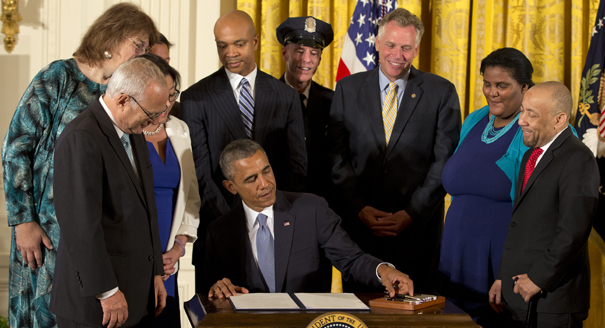
US President Obama Signs Executive Order Banning Discrimination Against LGBT Federal Employees and Contractors

Fulfilling a 2008 campaign promise, on July 21, 2014, President Barack Obama signed an Executive Order banning workplace discrimination against millions of lesbian, gay, bisexual and transgender employees of the federal government , as well as federal contractors and sub-contractors providing services to the federal government.

The Executive Order makes it illegal to fire or harass employees of the federal government because of sexual orientation or gender identity, going so far as to explicitly provide employment protection for transgender employees of the federal government.  The Executive Order also prohibits discrimination by federal contractors and sub-contractors, which affects approximately 24,000 companies employing close to 30 million workers, or roughly one-fifth of U.S. workers.

Rather than draft a new Executive Order, President Obama simply added the categories of sexual orientation and gender identity to existing Executive Orders that protect federal employees and employees of federal contractors and sub-contractors from discrimination based on race, color, religion, sex or national origin.  Read the full text of the Executive Order signed by the President.

Surrounded by LGBT supporters, including Virginia Governor Terry McAuliffe, third from right, President Barack Obama signs executive orders to protect LGBT employees from federal workplace discrimination in the East Room of the White House Monday, July 21, 2014, in Washington. Obama’s executive orders signed Monday prohibit discrimination against gay and transgender workers in the federal government and its contracting agencies, without a new exemption that was requested by some religious organizations. (AP Photo/Jacquelyn Martin)

Employment Mediations – an Insider’s Guide Part 2

Time in any mediation is often both limited and precious.  Once it is underway there is little time for sorting out the preliminaries.   As a result, it is customary for there to be contact between each of the parties (and/or their representatives) and the mediator(‘s staff) prior to kick-off.  For a judicial mediation arranged through the Employment Tribunal this will normally be a joint Case Management Discussion, but for commercial CEDR mediations of the sort I conduct, the mediator will usually seek to speak to each protagonist or representative separately first.

This serves a number of purposes.  It can deal with any outstanding administrative matters, especially to check that the mediation agreement (see next post) has been signed, and to ensure that my record of the parties’ names, contact details and intended attendees are correct.   In addition, I want to be sure that both parties will have full authority to settle on the day if terms can be agreed – while there is nothing wrong with that authority being subject to a phone call to someone more senior, it is essential to ensure that that someone will be available if and when the need arises.

That prior contact is also very useful to me in clarifying the parties’ respective experience of mediation.  Do they understand the ground rules about confidentiality, process, my neutrality and the outcome being in their hands, not mine?  Even where lawyers are instructed I would sooner have this call with the parties themselves, since it is they and not their lawyers who must ultimately be happy with the process.  However, this direct contact is not always feasible or indeed necessary if experienced representatives are acting.

If I have received all the mediation papers beforehand then I will use this prior contact to raise any remaining questions about the arguments or current state of the case.  If I have not, then I will seek a brief synopsis of what the issues are and where each party stands (and thinks the other stands) in relation to settlement.  Last, since much of the power of the mediation process is borne of the trust the parties must have in the mediator’s discretion and understanding of their position, I will also use this call to try to establish the beginnings of a rapport with them, to make some small talk to create a little bond or to find some point of common interest with the party.  This is particularly true with individual claimants as they are generally the least familiar with or convinced about the process and building that rapport helps turn me from an external stranger into someone to whom they can open up and feel secure that their trust will not be betrayed.

Next, the formal mediation agreement itself, what it says and why you have to sign it.

French Employer Successfully Challenges Costs Incurred By Works Council

Works Councils in France have the right under the Labour Code (Article L.2325-35) to appoint a chartered accountant to assist them with activities such as the annual review of accounts, advice on the strategic direction of the employer company and collective redundancies.  Companies are obliged to pay for the accountants in those circumstances.  If a Works Council appoints an accountant for matters outside Article L.2325-35, it must bear the costs itself.

The fees incurred by chartered accountants instructed by Works Councils can sometimes be very high, but the French courts have traditionally been reluctant to interfere, partly because of the risk of being seen to undermine the quality of the advice provided to the Works Council by limiting the cost of it.  Similarly, French employers have fought shy of challenging the bills because it will bring them into direct conflict with the Works Council in question.  This month, however, the French Court of Appeal upheld an employer’s challenge to the level of fees incurred by accountants advising its Works Council.

Progexa, a firm of accountants, was instructed by the Works Council at Pilpa to examine whether there was a right to raise an alarm (“droit d’alerte”), to undertake a review of accounts and to review a collective redundancy plan. In total Progexa’s bill came to €155,739 (of which approximately €17,000 was for “professional expenses”).  Pilpa challenged the level of fees billed by Progexa and was successful before the Tribunal de Grande Instance in Paris.  Progexa reimbursed €46,000 to Pilpa.  At the same time it lodged an appeal, but the Court of Appeal in Paris has this month upheld the Tribunal’s decision. It also went on to order Progexa to pay part of the costs of the appeal.

This is a rare result and reflects the finding that the bill presented by Progexa was some 30% overstated.  It shows that employers can and should challenge the fees incurred by accountants in advising their Works Councils where the amount billed is felt to be disproportionate to the services rendered.  Our advice is however that such challenges are best limited to very material over-billing.  Otherwise employers face the risk that the costs of the challenge exceed the amount recovered and that they do a degree of damage to employment relations in the workplace which is disproportionate to any actual saving of cash.

The Labour and Employment team in our Paris office acted for Pilpa (R&R Group) in this matter.

LexBlog
